Always know where your squad is.
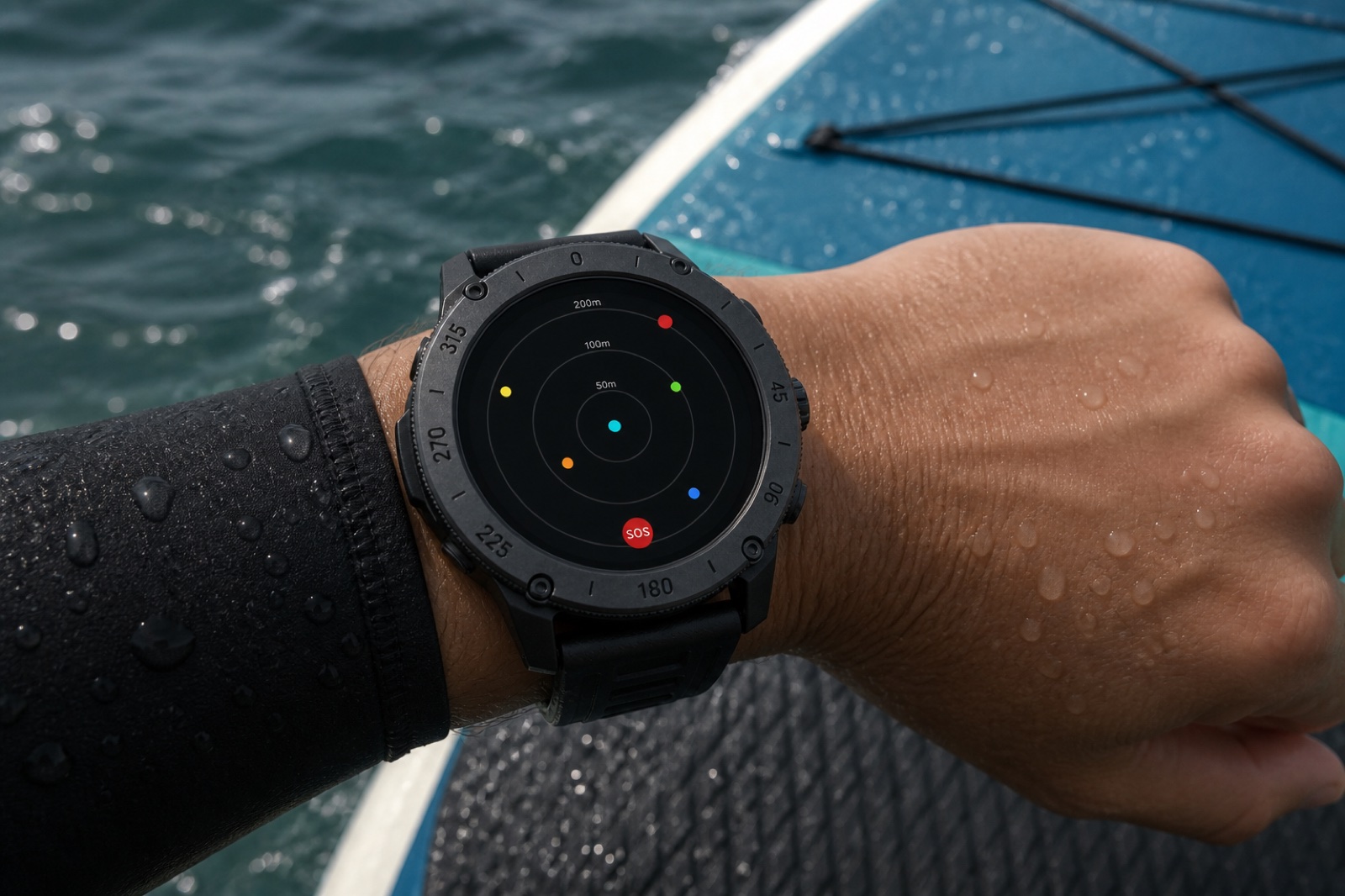
A small waterproof device that shows your paddling group's direction and distance to each other — plus a one-press SOS. No cell signal required.
Groups drift apart before anyone notices
Fog rolls in. The sun drops. You're paddling low to the water, and the person who was next to you five minutes ago is suddenly just... gone. It happens more than people realize.
Drifting apart
No landmarks on open water. Fog, glare, and low-sitting positions make it easy to lose sight of your group without realizing how far you've spread out.
Slow to get help
A phone in a waterproof bag is useless once it's wet. A beacon light just flashes and hopes someone passing notices. Satellite messengers notify a family member or a monitoring center — help that's miles away and takes real time to arrive. None of them reach your own teammates, who are already on the water and close enough to paddle straight over.
There's no lightweight, affordable device built for this
Satellite messengers run $300+ plus a subscription, and the help they call is never the people actually closest to you. Nothing on the market lets a group see each other's position continuously, or gets an SOS straight to the teammates who can reach you first.
Three steps, no setup
Clip it on
Attach the device to your PFD or wrist — waterproof, no phone required.
See your squad
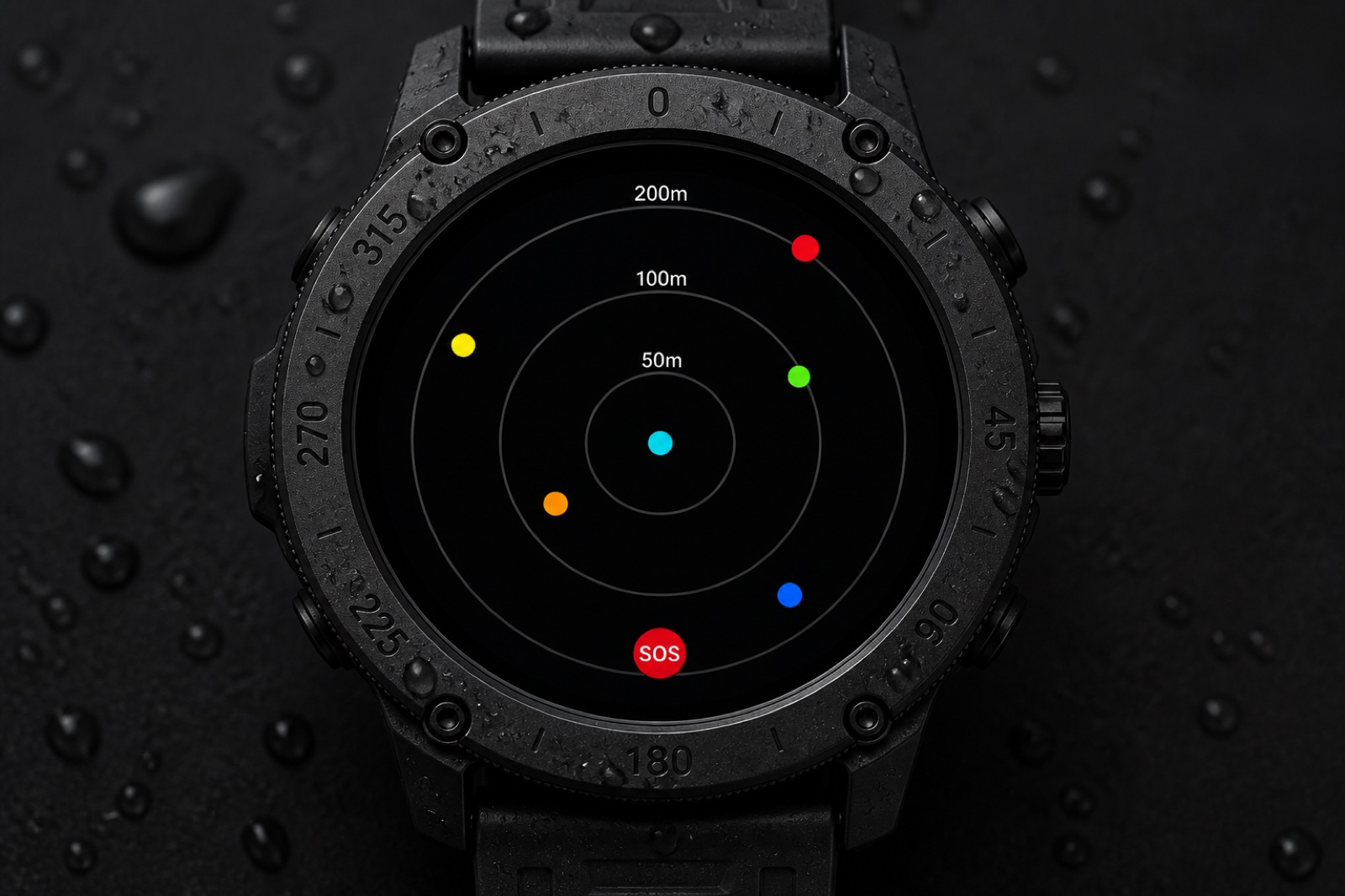
The screen shows the direction and distance to everyone in your group, in real time.
Press SOS if it counts
One large button. Long-press to trigger — vibration and a signal light confirm it went through.
Pick the range you need
Same core experience — direction, distance, SOS. Different comms for different water.
Short-range
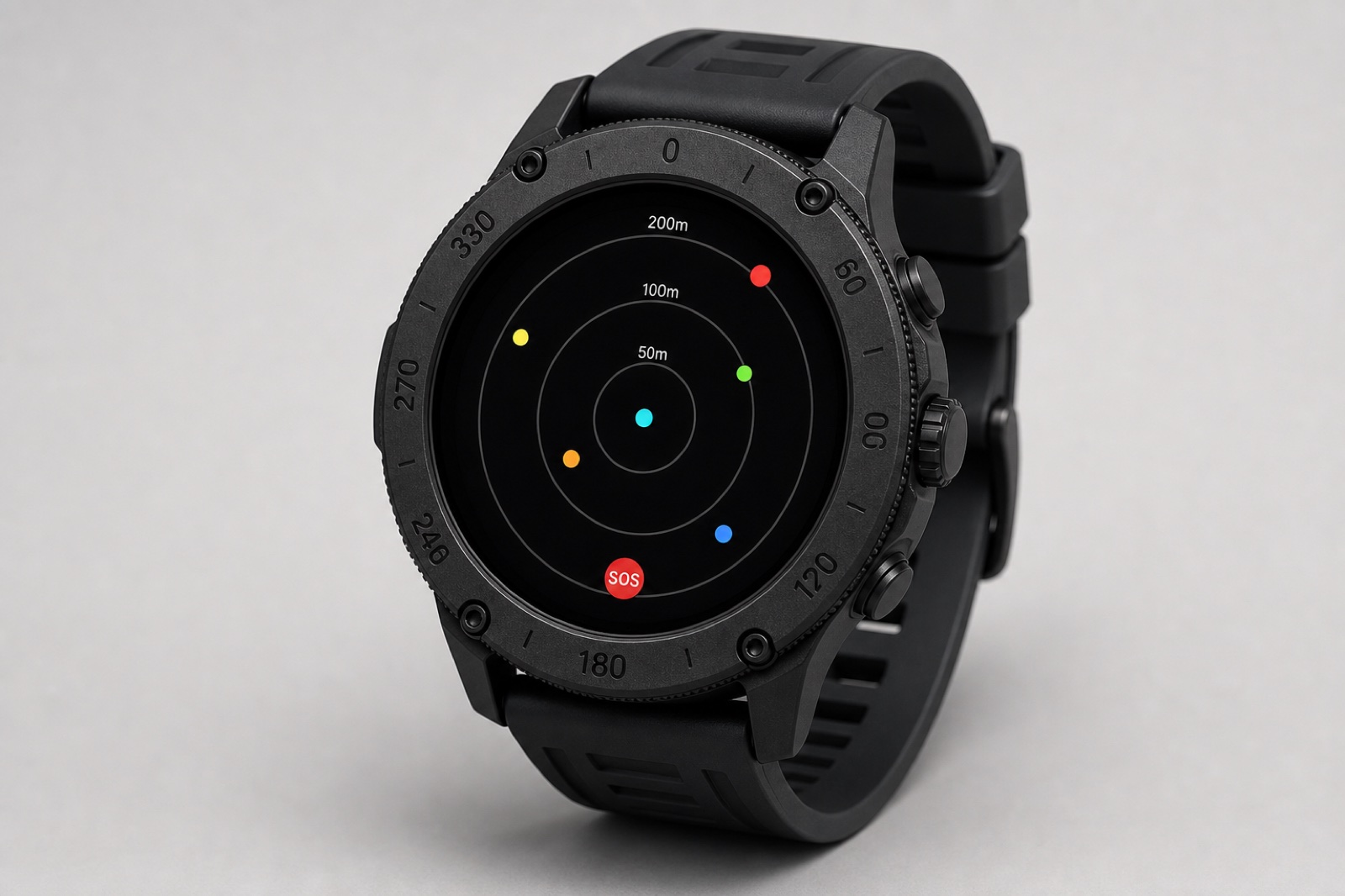
Daily paddling, lakes & near-shore
- Direct device-to-device, no network needed
- Built for staying together on a normal group paddle
- One-time purchase, no subscription
Long-range
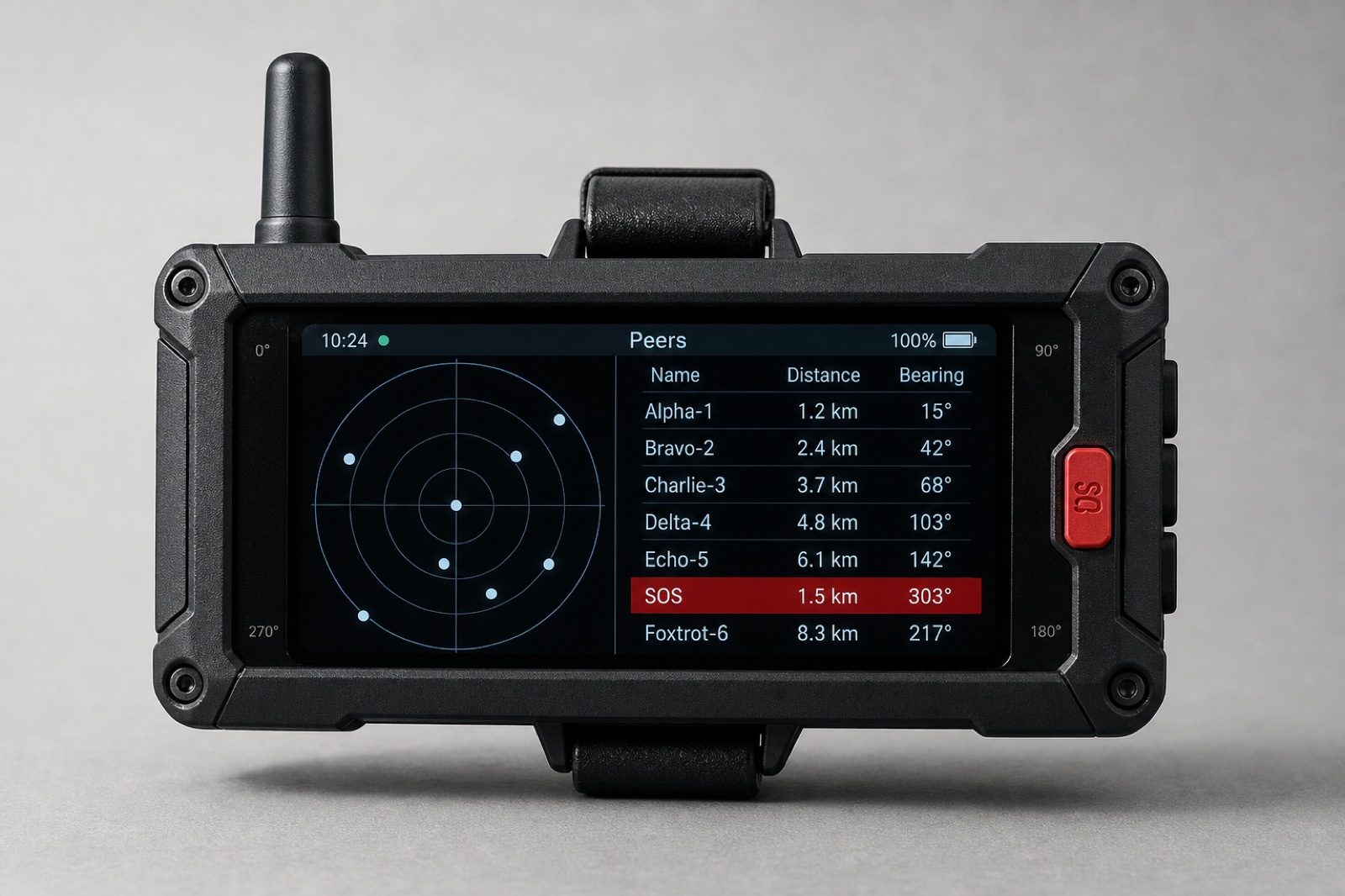
Open water, multi-day, out of sight of shore
- LoRa + cellular (LTE-M/NB-IoT); satellite under evaluation
- A backstop for worst-case, out-of-range emergencies
- May include a data plan depending on the final comms path
Now, and what comes next
Relative position
See the direction and distance to every teammate on the screen, updated in real time.
Drift alert
Get warned automatically when someone crosses a distance threshold — before it becomes a problem.
Heartbeat / offline detection
Devices broadcast a periodic signal; lose it for too long and the group gets a "signal lost" warning.
One-press SOS
Long-press the button and every teammate's device lights up with an alarm, your direction, and your distance — the people already closest to you know instantly and can start paddling over. Your own device vibrates and confirms it went through.
Quick signals
Wind and waves make talking across the water useless. A couple of large buttons send simple preset messages instead — "regroup here," "heading your way" — right to your teammates' screens. Physical buttons on purpose, not a touchscreen: wet fingers cause false touches or no touch at all, exactly when it matters most.
Fall / overboard detection
Motion sensing flags a sudden fall; auto-triggers SOS after a countdown (cancel anytime).
External warning light
On top of the alert your teammates already got, a bright flash + tone when SOS triggers helps passing boats spot you too.
Companion app
Cloud-synced route history, family sharing so someone on shore always knows where you are, community route-sharing and leaderboards, fine-grained tide and wind forecasts, and custom presets for your quick-signal buttons.
Waterproof & buoyant
IPX7+ rated and self-floating if it comes off in the water.
Built for paddling first. Not just for paddling.
Any group activity where you can drift apart and lose signal has the same problem — we're validating on the water first.
Hiking & backpacking
Groups spread out over distance; remote areas make finding someone harder.
Skiing & snowboarding
Different speeds split groups fast, often in poor visibility.
Hunting
Teams spread across terrain need to know where everyone is to stay safe.
Cycling & off-roading
Lead and tail riders lose track of each other on long routes.
Tell us where else you'd use this — reply to any update email.
Why I'm building this
A few months ago I read about four paddleboarders on a river in Washington State — the group included an 8-year-old girl. Wind and waves pushed them steadily away from shore, and before anyone realized how far they'd drifted, the group had come apart. Two of them ended up in the cold water. Sheriff's deputies had to launch a rescue boat through rough conditions to bring everyone in, and by the time they reached shore, the kids needed treatment for cold exposure.
Nobody in that story did anything reckless. That's what got me — a normal group paddle, calm enough water that an 8-year-old was along for it, and it still went sideways in a matter of minutes. Because once a group spreads out on open water, there's no way to know how far apart you actually are until it's already a problem.
I looked into what's out there to prevent that. Satellite messengers like the Garmin inReach are built for solo emergencies — they don't tell you where the rest of your own group is, and they run $300+ plus a monthly subscription. Everything else is a phone in a waterproof bag, which is useless the moment it gets wet or you're not looking at the screen.
There's no small, affordable device that just tells a group where each other are — or that gets an SOS straight to the teammates already closest to you, instead of a monitoring center or family member miles away. That's the gap Squadwave is trying to close.
I'm building this in the open. If you paddle with a group — even just one other person — I'd love your input on what we're building.
— Galen, founder
Inspired by real incidents reported in local news.
When will Squadwave ship?
We're in early development — right now we're building and testing the first prototype. There's no fixed ship date yet, and we'd rather get it right than rush it. Join the waitlist and we'll email you at every real milestone (prototype, pre-order window, first units) — no spam, just actual progress.
Does it cost anything right now?
No. Joining the waitlist is free and doesn't commit you to anything. We'll tell you well before any pre-order window opens.
How is this different from a Garmin inReach or similar?
A satellite messenger calls for help far away — a family member or a monitoring center who then has to figure out how to reach you. Squadwave's SOS goes straight to your teammates' devices, the people already on the water and closest to you, with your exact direction and distance. They can start paddling over before any outside rescue would even be dispatched. It's also built for the group the whole time, not just the emergency — and at a fraction of the $300+-plus-subscription cost.
Why not just use my phone or an Apple Watch?
Phones and watches check in over cell service or Bluetooth. Cell towers don't reach most of the water you're on, and Bluetooth tops out around 30 meters — nowhere near enough once a group spreads out. The short-range version talks device-to-device directly: no phone, no cell signal, no server in between. It keeps working exactly where phones and watches stop.
Why physical buttons instead of a touchscreen?
Touchscreens misread wet fingers — water on the glass causes false touches or just stops registering, which is exactly why car safety regulators are pushing back on touchscreen-only controls (Euro NCAP's 2026 rules require physical buttons for the horn, hazard lights, wipers, and emergency call to earn a 5-star rating). A safety device shouldn't get less reliable the moment it's actually wet. SOS and the quick-signal buttons are large and physical on purpose — they work with soaked, gloved, or cold hands.
How many do I need?
One per person in your group — knowing where everyone else is only works if enough of your group has one. We're planning multi-packs for exactly this reason.
Be part of the first group.
Join the waitlist — we'll only email you when there's real progress to share.
Run a club, rental shop, or event?
We're especially interested in talking to early group and organization partners.
Get in touch →